Tabari
Skip to main content
  • About
  • Artists
  • Exhibitions
  • Out of frame
  • Menu
  • About
  • Artists
  • Exhibitions
  • News
  • Publications
  • Contact
  • Out of frame
  • Privacy Policy
Menu

Tabari Artspace Presents Hazem Harb at Art Basel

3 - 7 February 2026

Tabari Artspace Presents Hazem Harb at Art Basel

Past Exhibitions exhibition
3 - 7 February 2026
  •  

    Harb's project mobilises archaeology as a critical framework through which to examine displacement, circulation, and the epistemic violence embedded in the production of historical knowledge.


    Tabari Artspace presents a solo booth dedicated to Palestinian visual artist Hazem Harb at Art Basel, Qatar, 2026. Drawing together works produced across distinct moments in his practice, from 2018 to the present day, the presentation brings collage and installation into dialogue around a sustained concern with how objects, images and people are extracted, transported and reclassified across time and space.

  •                                                                                            
  • Harb’s engagement with archaeology emerged early in his practice, notably in works produced in 2018 and first exhibited at Jaou...
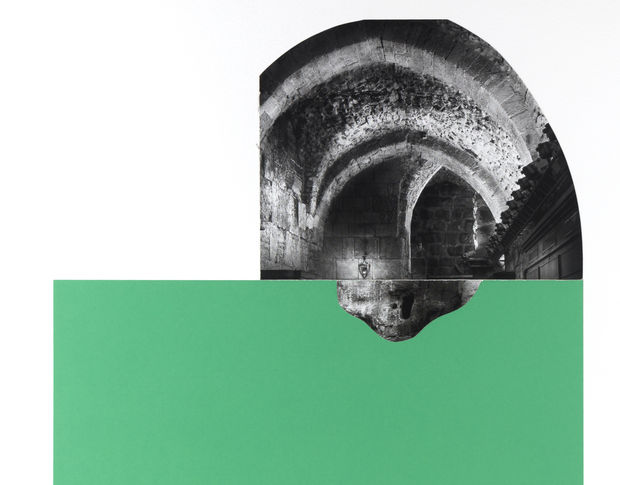
    Harb’s engagement with archaeology emerged early in his practice, notably in works produced in 2018 and first exhibited at Jaou Tunis. In Reformulated Archaeology (2018), a series from which several works are presented here, Harb layers fragments of landscape, anatomical forms and remediated original images of artefacts absorbed from locations across Palestine, many Neolithic figurines. Stripped of colour and detached from their original sites, these elements are recomposed into dense pictorial structures that examine the relationship between people, place and the institutional management of culture. Artefacts circulate here in ways that mirror their encounter within Western museum systems, catalogued and displayed through institutional frameworks in cities such as London, New York and Paris.
     
    These forms register the transformation of cultural heritage into objects of classification, rendered legible through colonial regimes of knowledge. Harb’s compositions make this process visible by collapsing geographic, bodily and material references into a single field, foregrounding the mechanics of extraction, ownership and access. Pieces of these figurines -torsos and faces - recur as central motifs, layered and encircled by thorn-like forms that suggest containment and restriction. Their biomorphic appearance, often evoking viral or bacterial structures, frames imperial extraction as a pathological condition embedded within social and institutional systems. Harb treats the past as a field shaped by discontinuity, power and revision: a genealogical approach (see Foucault) that refuses linear historical narratives in favour of fragmented, contested accounts. 
  • (Larger version of this image opens in a popup).
    (Larger version of this image opens in a popup).
    (Larger version of this image opens in a popup).
    (Larger version of this image opens in a popup).
    (Larger version of this image opens in a popup).
    (Larger version of this image opens in a popup).
    (Larger version of this image opens in a popup).
    (Larger version of this image opens in a popup).
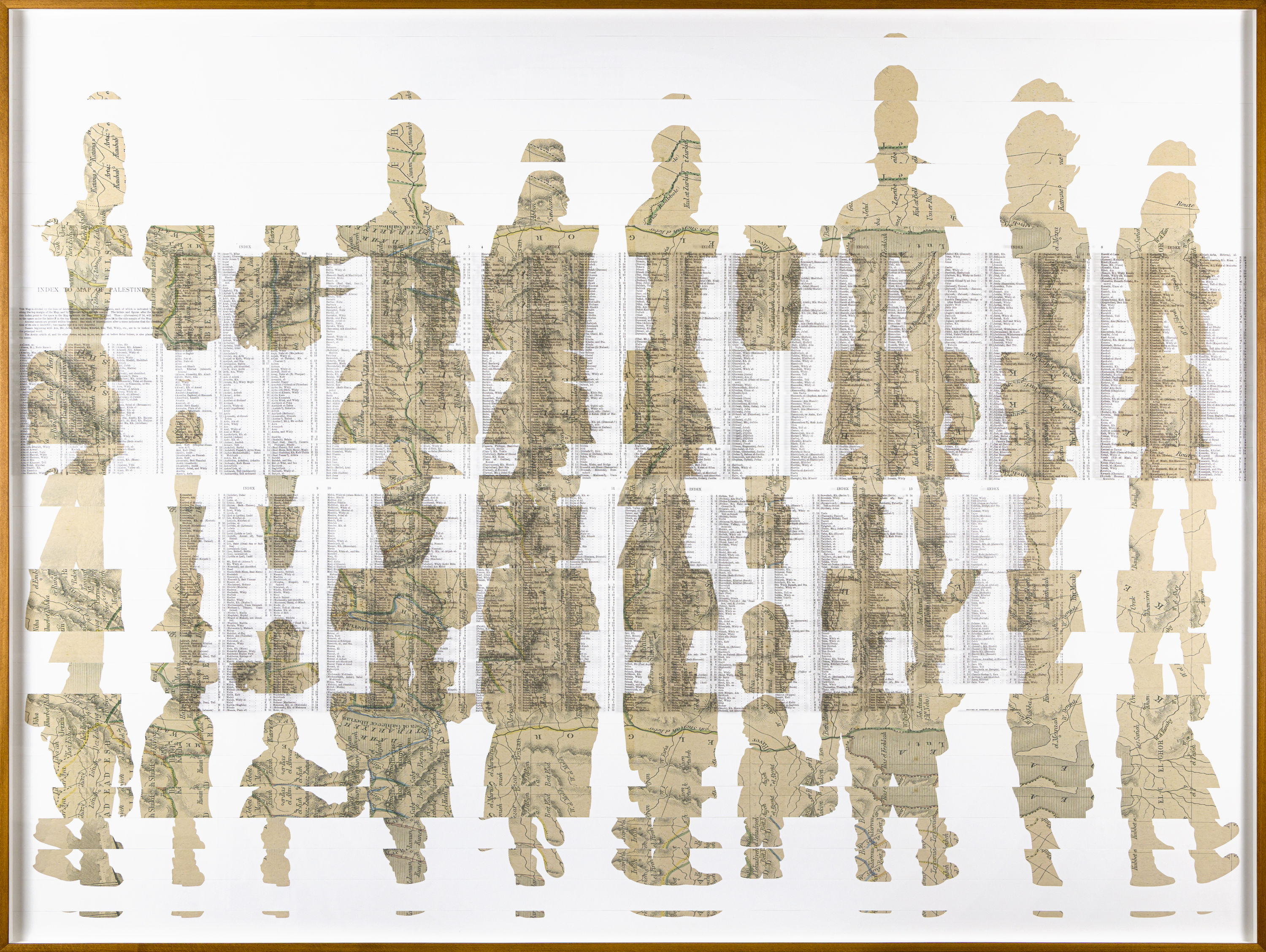
  • This concern with the politics of representation extends to the cartographic archive. In Victims of a Map (2025), Harb works with historical maps, reassembling them into abstract figural forms that evoke a human landscape fractured by occupation. The work addresses the disappearance of villages, towns, and neighbourhoods from official records, constructing a fictional geography that stands in for places rendered absent through processes of mapping and reclassification.


    Names of these erased locations are inscribed onto transparent glass, allowing figures and text to overlap and shift in relation to one another. Through this layered construction, Harb foregrounds mapping as an instrument of power, exposing its role in producing loss, marginalisation, and historical amnesia.

  • Returning to archaeological enquiry eight years later, Harb’s newly produced Future Archaeology (2025) adopts a speculative approach. The works are... Returning to archaeological enquiry eight years later, Harb’s newly produced Future Archaeology (2025) adopts a speculative approach. The works are...

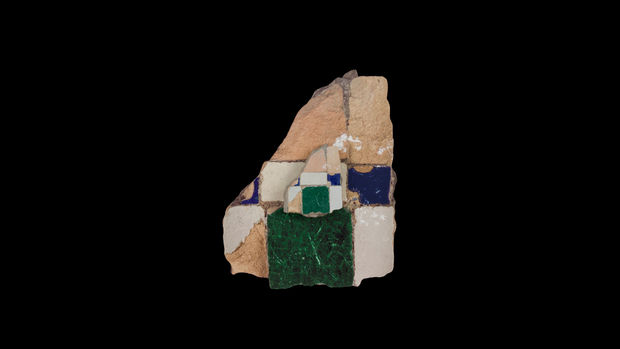
    Returning to archaeological enquiry eight years later, Harb’s newly produced Future Archaeology (2025) adopts a speculative approach. The works are produced from fragments of tiles retrieved from Palestine’s former airport, a site that has since become an inaccessible military zone.

    Entering the site with a fellow artist, Harb collected remnants from a fountain designed by a Moroccan architect, later subjecting these materials to processes borrowed from architectural practice - scanning, cataloguing and amplification. These fragments were enlarged and recombined with their original forms, drawing attention to the act of documentation and its role in conferring value. The airport functions here as a charged architectural and symbolic space. As a site designed to facilitate mobility and transnational connection, its abandonment reflects a broader condition of suspended movement and exile. Harb treats these fragments as potential evidence of interrupted futures, positioning them within a speculative timeframe that asks how histories of displacement will be read and interpreted in years to come. 

  • (Larger version of this image opens in a popup).
    (Larger version of this image opens in a popup).
    (Larger version of this image opens in a popup).
    (Larger version of this image opens in a popup).
    (Larger version of this image opens in a popup).
  • Press
    • Hazem Harb, poetic archival installation, 2026, Tabari Artspace, Art Basel Qatar

      Art Basel Qatar and the Art of Slowing Down

      Virginie Puertolas Syn, Artlyst, 10 February 2026
    • Hazem Harb, archaeology-based installation, 2026, Tabari Artspace booth, Art Basel Qatar

      Slow and Purposeful: Art Basel Qatar 2026

      Valentina Buzzi, Art Asia Pacific, 9 February 2026
    • Hazem Harb, Reformulated Archaeology, 2026, archival print and collage, Tabari Artspace

      The 10 Best Booths at Art Basel Qatar 2026

      Arun Kakar, Artsy, 4 February 2026
Back to exhibitions

TABARI ART GALLERY
THE GATE VILLAGE
BLDG. 3, LEVEL 2, DIFC, DUBAI
PO BOX 506759

gallery@tabariartspace.com
+971 4 323 0820

Artsy, opens in a new tab.
Instagram, opens in a new tab.
Accessibility Policy
Cookie Policy
Manage cookies
Legal
Accessibility
© 2026 Tabari Artspace
Site by Artlogic

This website uses cookies
This site uses cookies to help make it more useful to you. Please contact us to find out more about our Cookie Policy.

Manage cookies
Reject non essential
Accept

Cookie preferences

Check the boxes for the cookie categories you allow our site to use

Cookie options
Required for the website to function and cannot be disabled.
Improve your experience on the website by storing choices you make about how it should function.
Allow us to collect anonymous usage data in order to improve the experience on our website.
Allow us to identify our visitors so that we can offer personalised, targeted marketing.
Save preferences
Close

Join our mailing list

Signup